


Why Professional Bill of Quantities Services Are Essential for Successful Construction Projects

Updated: Jul 15
Construction projects succeed when costs, materials, labor, and timelines are carefully planned from the beginning. One of the most important documents that helps achieve this level of planning is a Bill of Quantities (BOQ). Whether you're a contractor, builder, developer, architect, or property owner, professional bill of quantities services can provide the clarity and cost control needed to keep your project on track.
A well-prepared BOQ not only helps estimate project costs accurately but also supports procurement, tendering, budgeting, and project management throughout the construction lifecycle. In today's competitive construction industry, relying on rough estimates is no longer enough. Detailed quantity surveying and cost planning are essential for minimizing risks and maximizing profitability.
This guide explains everything you need to know about bill of quantities services, including their purpose, benefits, preparation process, and why they play a critical role in successful construction projects.
What Are Bill of Quantities Services?
Bill of Quantities services involve the preparation of a detailed document that lists all materials, labor, equipment, and work items required for a construction project. The BOQ provides a systematic breakdown of quantities and descriptions for every construction element, allowing project stakeholders to understand the scope and cost of work before construction begins.

A Bill of Quantities is typically prepared by experienced quantity surveyors who analyze architectural drawings, structural plans, specifications, and project requirements to calculate precise quantities.
The primary purpose of a BOQ is to:
Define the project scope clearly
Measure quantities accurately
Facilitate competitive tendering
Improve cost planning and budgeting
Support procurement decisions
Reduce financial risks during construction
By providing a detailed overview of project requirements, a BOQ becomes a valuable reference document for contractors, subcontractors, suppliers, and project owners.
Why Are Bill of Quantities Services Important?
Construction projects involve hundreds or even thousands of individual components. Without accurate quantity measurement and cost planning, projects can quickly exceed budgets and face delays.

Professional BOQ services help eliminate uncertainty by providing reliable data for decision-making.
Accurate Project Budgeting
One of the biggest advantages of a Bill of Quantities is improved budget accuracy. Instead of relying on assumptions, project teams can make financial decisions based on measured quantities and detailed cost information.
This helps stakeholders:
Establish realistic budgets
Secure financing
Allocate resources efficiently
Monitor expenditures throughout the project
Better Cost Transparency
A BOQ breaks down project costs into individual work sections and trades. This transparency makes it easier to understand where money is being spent and identify areas for cost optimization.
Efficient Procurement Planning
Procurement teams can use BOQ documents to purchase materials and equipment more effectively. Knowing exact quantities helps prevent over-ordering, under-ordering, and unnecessary material waste.
Reduced Construction Risks
Unexpected costs are one of the leading causes of project disputes and budget overruns. A professionally prepared BOQ reduces the likelihood of errors and omissions that can impact project profitability.
Improved Tendering Process
Tendering becomes more accurate and competitive when contractors bid using the same BOQ document. This creates a level playing field and allows clients to compare bids fairly.
What Is Included in Professional BOQ Services?
A comprehensive Bill of Quantities contains much more than a simple list of materials. Professional BOQ preparation services provide detailed information across all project elements.

Quantity Measurement
The foundation of every BOQ is accurate quantity measurement. Quantity surveyors calculate dimensions, areas, volumes, lengths, and counts for all construction components.
Examples include:
Concrete volumes
Masonry quantities
Reinforcement steel
Flooring areas
Roofing materials
Structural elements
Material Quantification
Material takeoff is a critical part of BOQ preparation. This process identifies the exact quantities of materials required for project completion.
Common materials include:
Cement
Sand
Aggregates
Steel
Timber
Drywall
Tiles
Paint
Labor Cost Breakdown
Labor often represents a significant portion of construction costs. Professional BOQ services help estimate workforce requirements and associated labor expenses.
Equipment Cost Analysis
Construction projects require various machinery and equipment. BOQ documents may include:
Excavators
Cranes
Concrete pumps
Earthmoving equipment
Temporary site facilities
Trade-by-Trade Costing
Projects are typically divided into individual trades such as:
Site preparation
Concrete works
Structural steel
Carpentry
Electrical systems
Mechanical systems
Plumbing
Finishes
This structure simplifies cost control and contract administration.
Tender Documentation
BOQ documents are commonly used during the tendering process. Contractors use them to prepare competitive and accurate bids while clients use them to evaluate proposals.
Types of Bill of Quantities Services
Different construction sectors require specialized BOQ preparation. Professional quantity surveying firms often provide tailored services based on project type.
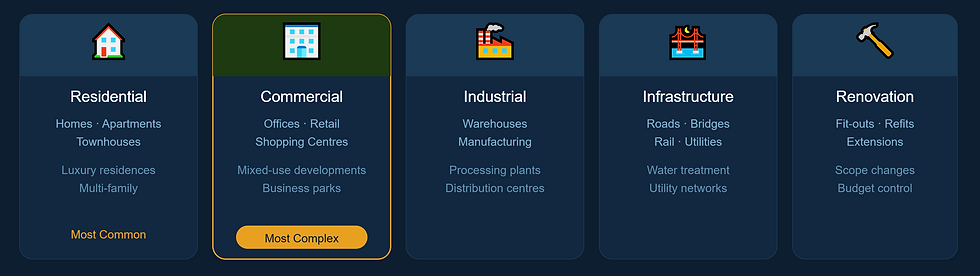
Residential BOQ Services
Residential projects include:
Single-family homes
Multi-family developments
Apartment buildings
Luxury residences
Townhouse projects
Residential BOQs help homeowners and builders understand construction costs before work begins.
Commercial BOQ Services
Commercial developments often involve larger budgets and greater complexity.
Examples include:
Office buildings
Shopping centers
Retail spaces
Mixed-use developments
Business parks
Commercial BOQs support cost planning and investment decision-making.
Industrial BOQ Services
Industrial projects require specialized quantity measurement and cost estimation for:
Manufacturing facilities
Warehouses
Processing plants
Distribution centers
Infrastructure BOQ Services
Infrastructure projects involve extensive planning and detailed quantity calculations.
Examples include:
Roads
Highways
Bridges
Rail projects
Water treatment facilities
Utility networks
Renovation and Fit-Out BOQ Services
Renovation projects often present unique challenges due to existing site conditions. Detailed BOQs help manage scope changes and budget expectations.
Bill of Quantities vs Quantity Takeoff
Many construction professionals use these terms interchangeably, but they are not the same.
Bill of Quantities (BOQ) | Quantity Takeoff |
Detailed construction document | Measurement process |
Includes descriptions and quantities | Includes quantities only |
Used for tendering and contract pricing | Used primarily for estimating |
Covers complete project scope | Focuses on material quantities |
Supports procurement and budgeting | Supports preliminary cost estimation |
A quantity takeoff is often one step in the BOQ preparation process. The completed BOQ expands on these measurements by organizing them into a structured document suitable for tendering and project management.
How Professional BOQ Services Are Prepared
Preparing a high-quality Bill of Quantities requires technical expertise, industry knowledge, and attention to detail.
Step 1: Review Project Drawings and Specifications
Quantity surveyors begin by studying:
Architectural drawings
Structural drawings
Mechanical plans
Electrical plans
Specifications
Contract documents
Understanding the full project scope is essential before measurements begin.
Step 2: Perform Quantity Measurement
All project elements are measured according to industry-standard methods of measurement.
This stage involves:
Calculating areas
Measuring lengths
Determining volumes
Counting components
Step 3: Categorize Work by Trade
Measured quantities are organized into construction trades and work packages.
This improves document clarity and supports contractor pricing.
Step 4: Conduct Cost Analysis
Cost planning professionals evaluate labor, materials, and equipment requirements to develop accurate pricing structures.
Step 5: Compile the BOQ Document
All information is organized into a formal Bill of Quantities that includes:
Item descriptions
Units of measurement
Quantities
Trade sections
Pricing schedules
Step 6: Quality Assurance Review
A final review helps identify:
Missing items
Measurement errors
Scope inconsistencies
Documentation issues
This step ensures the highest possible level of accuracy.
Benefits of Outsourcing Bill of Quantities Services
Many contractors and developers choose to outsource BOQ preparation to specialized quantity surveying firms.
Access to Experienced Quantity Surveyors
Professional firms employ specialists who understand industry standards, measurement techniques, and cost management principles.
Improved Accuracy
Experienced estimators use advanced software and proven methodologies to produce reliable quantity calculations.
Faster Turnaround Times
Dedicated BOQ professionals can often complete estimates more efficiently than in-house teams.
Reduced Operational Costs
Outsourcing eliminates the need to maintain a full-time estimating department while still providing access to expert services.
Advanced Estimating Technology
Modern BOQ providers utilize industry-leading software solutions for:
Digital takeoffs
Cost estimating
BIM integration
Project cost management
Industries That Use BOQ Services
Bill of Quantities services are valuable across numerous sectors within the construction industry.
Residential Construction
Builders use BOQs to improve budgeting accuracy and manage construction costs effectively.
Commercial Development
Developers rely on BOQs for tendering, procurement, and financial planning.
Healthcare Facilities
Hospitals and medical centers require detailed cost planning due to their technical complexity.
Educational Buildings
Schools, colleges, and universities benefit from accurate quantity surveying and budget management.
Hospitality Projects
Hotels, resorts, and entertainment venues often use BOQs to control costs during development.
Retail Construction
Retail projects require detailed planning to ensure timely project delivery and cost efficiency.
Infrastructure Development
Public and private infrastructure projects depend heavily on quantity surveying and BOQ documentation.
Common Mistakes in BOQ Preparation
Even small errors can significantly impact project budgets and profitability.
Missing Quantities
Overlooking construction elements can result in cost overruns and contract disputes.
Incorrect Units of Measurement
Using the wrong measurement units can distort project estimates and procurement plans.
Outdated Cost Information
Construction material and labor costs change frequently. Accurate BOQs require current market data.
Scope Omissions
Incomplete project understanding can lead to missing work items and inaccurate budgeting.
Poor Documentation
Unclear descriptions can create confusion during tendering and project execution.
Lack of Quality Control
Failure to review calculations increases the risk of costly mistakes.
How to Choose the Right Bill of Quantities Service Provider
Not all BOQ providers offer the same level of expertise and accuracy. Choosing the right partner can significantly impact project success.
Industry Experience
Look for firms with proven experience in your specific project sector.
Qualified Quantity Surveyors
Ensure the provider employs trained quantity surveyors with relevant construction knowledge.
Technology and Software Capabilities
Modern estimating tools improve efficiency, consistency, and accuracy.
Turnaround Time
Project schedules often depend on timely BOQ delivery. Choose a provider that can meet your deadlines.
Quality Assurance Process
Ask about their review procedures and quality control measures.
Client Testimonials and Portfolio
Past project experience can provide valuable insight into service quality and reliability.
Scalability
The provider should be capable of handling projects of varying sizes and complexity.
How Bill of Quantities Services Contribute to Cost Savings
One of the biggest misconceptions is that BOQ services are simply an additional project expense. In reality, they often generate significant cost savings.

Professional BOQ preparation helps:
Prevent material wastage
Reduce procurement errors
Improve contractor bid accuracy
Minimize change orders
Enhance project planning
Support value engineering initiatives
Improve cash flow forecasting
Reduce financial disputes
When construction costs are properly controlled from the planning stage, projects are more likely to remain within budget and achieve their financial objectives.
The Future of Bill of Quantities Services
As construction technology continues to evolve, BOQ preparation is becoming increasingly digital.
Emerging trends include:
Building Information Modeling (BIM)
Automated quantity takeoffs
Cloud-based estimating platforms
Artificial intelligence-assisted cost planning
Real-time project cost monitoring
These technologies help quantity surveyors improve efficiency while maintaining high levels of accuracy and reliability.
Conclusion

Bill of Quantities services play a vital role in modern construction project planning and cost management. By providing detailed quantity measurement, cost transparency, procurement support, and tendering documentation, a professionally prepared BOQ helps stakeholders make informed decisions throughout the project lifecycle.
If you are developing a residential property, commercial building, industrial facility, or infrastructure project, investing in professional BOQ preparation can reduce risk, improve budgeting accuracy, and increase the likelihood of project success.
In an industry where every cost matters, a detailed and accurate Bill of Quantities is not simply a document; it is a foundation for effective construction planning, financial control, and long-term project profitability.


